The discombobulation incident

Back then, the boy with the thick flowing hair of youth would leave home on the odd Saturday morning, and frown his way down the hill and around the bend to where Patsy the barber had been lowering ears since forever.

 In the everlasting fire of summertime, the door to Patsy’s humble shop stood wide open. While news of air conditioning had reached the neighborhood, most saw it as an expensive luxury. As did Pasquale Rinaldi, the meek Italian gentleman who chewed gum, said little, and worked alone six days a week cutting the hair of boys and men on Tipperary Hill.

 The shop’s dozen chromed chairs, covered in cracked, red vinyl never stayed empty for long. The men filled the room with smoke and loud talk; the itchy boys hovered around a table full of comic books spilling across a used checker board.  Superman, Archie and Sgt. Rock killed time. Even so, when the boy walked through that door on a Saturday morning, he saw his precious play time draining away like the last drop of a root beer float.

 As if waking from a dream, he finds himself stepping out of the fried hell of summer and into the chill of a shopping center salon. He looks uncomfortable to be in something called a salon, feels awkward to be the only male in sight. No comic books here, but plenty of glossy magazines about fashion, style, and other things, including hair, that he is short on just now.

 The woman at the cash register asks “How may we help you?” It likely never occurred to Patsy that he might be helping people. He was just cutting their hair.

 “Your stylist will be the lovely Candace,” says the woman, indicating a blonde in her thirties. Even with pierced nose and cheek she looks a lot better than Rinaldi the Great. At that moment, the lovely Candace brushes something off the back a colleague, the lovely Maggie.

 “Am I shedding?” asks Maggie with concern.

“We’re all shedding,” says the lovely Candace drily.

 On her table in front of the mirror stands a half-empty Big Gulp flanked by tubes, tubs, bottles and jars of goo and gaa.  A container of combs in disinfectant contrasts with the memory of Patsy picking a dropped comb from his hairy floor, wiping it on his pants and continuing to boogie.

 Candace says little and the haircut proceeds apace. Toward the end she notes a single, defiant white hair smugly undefeated in skirmishes of brush back and slick down.

 “It’s coarse,” she says, “not like the rest of your hairs.”

 Normally one would say “not like the rest of your hair,” but his days of thick youthful locks are gone. And the lovely Candace calls ‘em like she sees ‘em.

spArks.4

Ground control to Major Tom…

 “It’s like wire,” she adds. “There, I cut it off it.”

 Stunned, he blurts “You killed it?”

 “It was your antenna,” says Candace soothingly. “They can’t hear you anymore.”

 At checkout, he fumbles with the credit card machine. Candace says “It was that white hair. It’s got you all discomboobulated.”

 As he moves from the chill salon back to steamy trousers, he’s pretty sure the word is discombobulated. Whichever, that’s what he is. That never happened at Patsy’s, of course. But then, Patsy never said anything about an antenna. Or  the shedding.

©Patrick A. McGuire and A Hint of Light 2013, all rights reserved.
Posted in The human comedy | Tagged , , | 3 Comments

F.A.Q. The Elevator Speech

Q. What exactly is an elevator speech? 

A. Imagine you step onto an elevator and find yourself standing next to the Big Garbanzo Bean of the company you’re dying to work for. In the next 30 seconds, before the elevator reaches the floor where the BGB gets off, you have an opportunity to sell your qualifications and state how your talents are precisely what that company needs in an employee.

Q. So the speech doesn’t have to be about an elevator? 

A. No. Unless the BGB runs an elevator company.

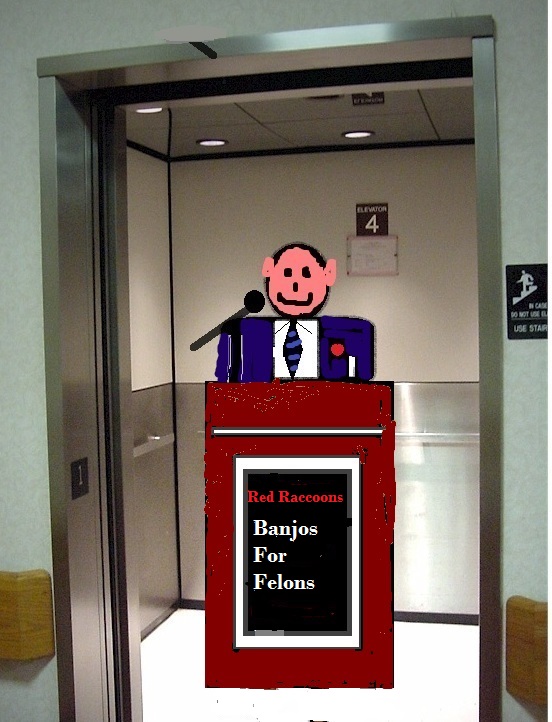
Q. What’s the main difference between an elevator speech and a speech down at the weekly luncheon of the Red Raccoons?

A. Red Raccoons?

Q. It’s the service club I belong to. We try to expose convicted felons—like murderers and drug dealers—to bluegrass music.

A. As a form of punishment?

Q. Oh no. We believe that the kind of music they listened to before they were felons—usually loud, angry hip hop and rap music without any banjo in it at all, contributed to their societal downfall. We think a complete change of music will inspire them to spend their time picking and grinning when they get out of prison. 

A. You’re talking about teaching hardened drug dealers to play the banjo?

Come on in, lots of room

Come on in, lots of room

Q. And the fiddle and the mandolin and the dobro. And don’t forget singing in that high lonesome harmony. That can really move you. 

A. So can a bowl of green chili.

Q. By the way, we insist each felon sign a pledge vowing to give up whatever crime it was that got them in trouble–like drug dealing and murdering. If we hear about them dealing drugs or murdering somebody we take back their instruments and kick them out. You’d better believe that sends a message that we’re serious. 

A. I was just going to ask if you were serious.

Q. You’d better believe we’re serious. 

A.  Right. So where were we?

Q. I asked you what was the difference between an elevator speech and a speech down at the Red Raccoon’s weekly luncheon. 

A. See, an elevator speech isn’t really a speech. That’s just a metaphor. Think of it more like a very focused sales pitch. Instead of selling a car or an insurance policy, you’re selling yourself. Lemme ask you though. Do you have, like, a special raccoon handshake?

Q. It’s not like that. We don’t have a handshake or raccoon coats or a raccoon song. We don’t dress up like raccoons or make raccoon noises or ride around on tiny raccoon motorcycles. I told you, we’re a very serious bunch. So, when you start your elevator speech, you don’t have to acknowledge the people at the head table? Or make an announcement that somebody left their headlights on out in the parking lot? 

A. There wouldn’t be a head table on an elevator. Not usually.

Q. See, that’s exactly the kind of information I’ve been looking for

A. What if you had a convicted murderer who already listens to bluegrass music? Maybe even plays the banjo?

Q. We’re talking about a hypothetical case now? 

A.  Right.

Q.  I mean, we could also talk about how many angels can fit on the head of a pin, I suppose. 

A. You wouldn’t try to get that guy to listen to hip hop or rap would you?

Q. What? And risk exposing him to a life of crime and debauchery? 

A. But he’s already a criminal, remember? Hypothetically.

Q. You see, being as serious as we are, we deal only in real world issues.We try to leave the fiction to the historians. 

A.    You haven’t even considered that possibility, have you?

Q. I have another elevator speech question. May I continue? 

A.  Have you ever listened to a complete rap song?

Q. Can you give an elevator speech on an escalator? 

A. That would be an escalator speech, which is not my department. Off the top of my head I’d say an escalator is a completely different paradigm with a different set of epistemological expectations. Is it an escalator in a department store or one of those long things in an airport? Is the person you’re trying to give the speech to standing in the standing lane or walking—even running–in the passing lane? Maybe there’s an urgent need to find a restroom. Your escalator speech would have to consider all possibilities. But don’t quote me. Escalators are not my comfort zone.

Q. What happens when you get on an elevator and someone else is already giving an elevator speech to the person you want to speak to? 

A. Start laughing hysterically. Laughter is contagious. Pretty soon the Big Garbanzo Bean will be laughing too. If, however, you find you’re the only one laughing you might want to get off at the next floor.

Q. I live in a small town that has only one elevator. It’s down at our bank which has only two floors. The elevator is used exclusively by old man Moonan, the bank president. Plus there’s Wally Snortz’s grain elevator just outside of town. 

A. Do you want to work for old man Moonan?

Q. No, of course not. 

A. What about Wally what’s his name?

Q. Snortz. He’s my brother-in-law. 

A. Is that a yes or a no.

Q. No. 

A. There you have it then.

Q. There I have what? 

A. The essence of the elevator speech. To give one you must go where there are not only serious elevators but elevators with serious garbanzo beans on them. Look, how many of these convicted felons have you actually converted to bluegrass?

Q. None so far. We’re still looking for funding. 

A. Hmm. Have you considered approaching wealthy banjo players?

Q. Is that some kind of joke? 

A. Yes.

QSo what’s the most important thing about elevator speeches? 

A. Never give an elevator speech on an up elevator. People going up are usually just coming into work in the morning and are tired and grouchy. Or they’re riding to a higher floor than theirs for a meeting with the big boss who is probably going to ream them out for shoddy work on the Ferguson report. They might even be riding to the top of the building so they can jump off. The people on the down elevator, however, are usually going home, or out to lunch or safely back to their floor from the boss’s floor. So their spirits are bound to be higher and they are more likely to listen and to say yes. But watch out. They may be going down because they’ve been fired. No Banjo on Elevator

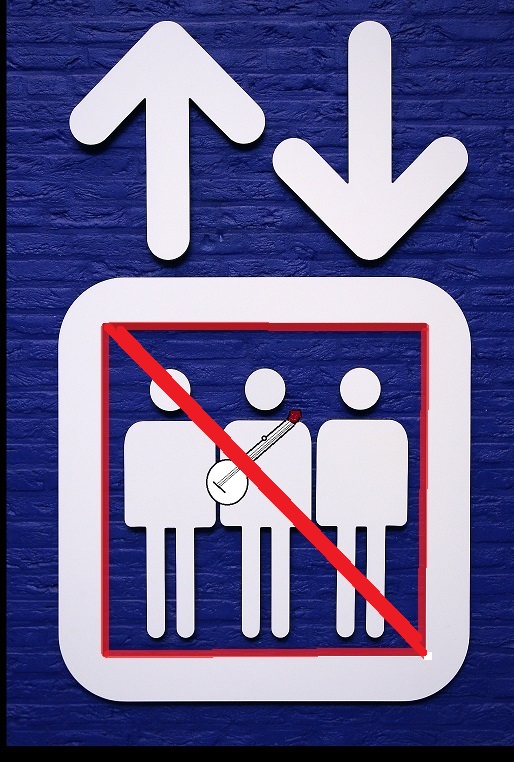
Q. Would it be okay if I brought my banjo along? You know, to do a little picking as kind of a musical background to my speech? 

A. Do you have a pencil? Write this down: Never–underline never three times–NEVER bring a banjo to an elevator speech.

©Patrick A. McGuire and A Hint of Light 2013, all rights reserved.
Posted in Absurd and/or zany, F.A.Q., News You Can Use (Sort of) | Tagged , , , , | 4 Comments

It is and it aint

Everyone, everywhere, is searching.

 Some search for what they once had but foolishly lost. They held it in their bare hands but it dribbled through their fingers. They left it out too long and it went bad. They accidentally flushed it down the toilet. They set it on the roof of their car while they fumbled with their latte and their keys and then drove off. Later, when they looked for it and didn’t see it, the sickening image of the car roof came to mind. Ever since, they have backtracked the byways of their past, desperately combing through brush and debris, their hair akimbo, their dreams reduced to the low mutter of the abashed.

 Those are the ones who had it to begin with. Some, though, search for it who never had it at all. They don’t really know where to look, except they don’t have to do any backtracking because they know where they’ve been and they know that when they were there, they weren’t even close to it.

 The most difficult part of their search: they don’t know what it looks like. It could bite them in the hind end—as things so often do—and they wouldn’t know any better than to slap their backsides and shout scram. At least those who had it but lost it will know it when they see it again, although statistics show that it seldom bites the same cheek twice.

Most people think those who lost it probably never deserved it in the first place. If only they themselves had it in the first place (they tell themselves convincingly), they’d still have it in the second place. They wouldn’t have to waste their time looking for it and getting blank stares from the grossly uninterested.

 To those who have no idea what they are looking for, the days are long and the nights filled with restless turning and tossing and getting up for antacids and a chapter in an old Hemingway paperback still on the dusty shelf with the original cash register receipt stuck in it from the day they bought it 42 years ago the night before the final on Modern Lit when they’d fallen asleep after three paragraphs and slept on through the exam and then had to go to summer school instead of to the ocean where they would have met a lonely tycoon and removed a thorn from his foot and then lived happily ever after. They go back to bed and stare at the ceiling until the ditzy morning drive team comes on four inches from their ear.

 These are some unhappy people. They want it so bad they can taste it. But it’s the kind of taste that is hard to pin down—Vegetable? Chicken? Is it even done? Is it robust and a bit peppery with just a hint of oak?  What is very sad is that the people who had it and lost it and who can describe it perfectly, and the people who have no idea at all what it looks like—they never talk to each other.

 There is one other group, a tiny minority who have it but won’t let it out of their sight. They dare not take it out for fear it will be spotted by those who once had it but lost it, or be blundered into by those who haven’t any idea it is there. And they might blunder into it hard enough to break it. This little group keeps it safely guarded and spends a good bit of time worrying that it isn’t guarded safely enough. After all, it is too valuable to risk losing, too valuable to risk enjoying. It is certainly not a play thing.

 In a way, this smaller group has much in common with the searchers. For both groups it has become the driving force of their lives. But while they won’t say so, they are all very, very tired of it. They would like to take a nap and just forget about it for a while.

 But they cannot.

 Because it is what it is.


©Patrick A. McGuire and A Hint of Light 2013, all rights reserved.

Posted in Absurd and/or zany, News You Can Use (Sort of) | Tagged , , , | 2 Comments

Oh manhole, my manhole

It’s not much of a street, just an old country short cut wedged in between two busy state highways. There’s a large dip about halfway along the road where it runs past an unlikely post office set up in a tiny and ancient cottage. Like the one where The Big Bad Wolf digested Granny. Can’t help thinking about the term “dead letter drop” whenever I go past.

Not too long ago the boys and girls down at the highway department came out and gave the road a new black top and a bright, double yellow stripe down its center from end to end. It was a nice gesture, gave the little road a boost of pride no doubt, hooking it up proper to those two highfalutin state highways. Smartened up the whole 300 yards of it, I’d say.

But two weeks later another group of hard hats set up shop, putting a screen around the road’s only manhole. They popped the cast iron manhole cover–bisected by that double yellow stripe like a pizza wheel halving a tomato pie.  Then the crew blocked traffic for a day or two while they crawled down into the hole, probing and sedating the intestines of a sleeping monster. They came back up, took down the screen and went on their way.

But ladies and gentlemen, things are not the same. Instead of taking care to reseat the manhole cover with its twin yellow end points connecting to the double lines on either side of it, they left it awkwardly off-center—cattywampus, if you will. Catty-damn-wampus! The orderly flow of the double yellow stripes is now rudely interrupted by a cockeyed yellow equal sign. It mocks the entire road, undermines the state highways, compromises the whole interstate system and therefore the bridges, the rivers, the lakes, our friend the loon, the oceans and, ultimately shames the entire planet.

Before dismissing this as the overwrought exaggeration of an obsessive-compulsive, answer this: Had it been you, wouldn’t you have spent the extra minute or so lining up the stripes?  Yeah, yeah, yeah, it’s a heavy damn piece of iron and it’s not as simple as lining up all the paper clips  on my desk in a straight line—which, by the way, presents its own challenges.

manhole cover drawing.5

NSA satellite photo of manhole cover in question

To me, it’s a basic issue of law and order. The double line is the law, the province of lawyers. But the straightness of the line is the order, and order is for all of us. How could they simply plop the cover back in place without being aware of such an egregious disconnect? I mean, did they even notice the stripes?

 Or consider this nightmare scenario: They saw the stripes all right. All part of a subtle conspiracy aimed at subverting the public order to foment anarchy. In the words of bullet-ready Bernard P. Fyfe  “We have to nip this in the bud.”

©Patrick A. McGuire and A Hint of Light 2013, all rights reserved.

Posted in Mockery and derision, The human comedy | Tagged , | 11 Comments

Trials of a One Per-Center

This gallery contains 9 photos.

More Galleries | Tagged , , | 7 Comments

Loud and 99% Clear

 Katherine and I have little trouble finding things to talk about over dinner or a refreshment at happy hour.  She likes to discuss books and philosophy—vis a vis the steps and missteps along life’s continuum—as well as lunatics she has encountered in her vast experience as a lunatic magnet. I end up talking books, philosophy—vis a vis what the hell vis a vis or continuum means—and the lunatics where I used to work because where I work now, in my basement, alone, there just don’t seem to be that many interesting nut jobs.

The other night the topic turned to movies, and I was waxing eloquent (not to be confused with waxing the elephant) about the characters and actors who play them in the continuum of Woody Allen movies. I mentioned a female actor in “Hannah and Her Sisters.” Here is the crisp dialogue that followed:

Katherine: “Well, Woody Allen always did like his women porky.”

Me: “Right.”

A heavy silence fell over the table like a waxed elephant. A little voice within me said “What do you mean, right?” I then found myself pondering. Mia Farrow, porky?  Louise Lasser, porky? And then I started to think, gee, porky is such a pejorative term and it is so unlike Katherine to be so blunt and unkind.

“Wait, a sec. Porky?”

“Porky?” she asked right back. “Who’s porky?”

“Mia Farrow,” I replied.

“You think Mia Farrow is porky?” She said this with the kind of biting astonishment that burns my leaves.

“No,” I continued, bristling at the sheer injustice of it, “you do.”

“Do not.”

“Do too. You said he liked porky women.”

Now she bristled, which is when I knew I’d lost. Women always bristle better than men.

“I said quirky.”

I paused to reflect.

“Ah,” I nodded. “Oh,” I said. “Quirky,” I delicately enunciated.

“Not porky. Why would I have said porky?”

“That’s just what I wondered,” I said. “It seemed so unlike you.”

“There’s a big difference, you know.”

“Oh, thanks,” I said, not meaning thanks at all. “I did not know that.”

The conversation ended when Katherine asked “Have you thought of seeing a herring specialist?”

I was going to say something, but an inner voice convinced me to quit talking while I was behind. The next day I made an appointment with a specialist and we spent an interesting hour discussing the merits of salted, smoked and pickled herring. Though I much prefer walleye, I have filed this experience under “The things you do for love.”

©Patrick A. McGuire and A Hint of Light 2013, all rights reserved.

Posted in The human comedy | Tagged , , | 6 Comments

Garbage in, garbage out

Is there anything more shaming than to set out your trash cans in the morning and then to come home at night and see that your cans are still full, but all of the neighbor’s cans have been emptied?

In your heart you know it’s not simply that the trash collectors unintentionally skipped your cans. Your cans are a bright, nuclear-dawn orange. You need sunglasses just to get within five feet of them. No, it goes deeper than oops we missed you pal, getcha next week.

As you stand at the curb staring in disbelief at your full cans, the neighbors are happily hauling their empties into their garages. Some are humming. Some are even whistling. But there you are on the brink of tears. Life is so damned hard and now this.

It’s not a matter of messing up the recycling. You have a separate can for metal, one for paper, one for plastic, one for last nights’ uneaten Brussels sprouts that never should have been let out of Belgium, one for multi-colored leftovers that got stuck in the back of the fridge behind the cantaloupe, one for cantaloupe strategically placed to hide the leftovers in the back, one for vacuum cleaner lint, one for dryer lint, one for upstairs junk, one for downstairs junk, one for impure thoughts, one for Peter, two for Paul, three for Him who made us all.*

Deep down inside you know what happened. Your garbage simply wasn’t good enough for the discriminating eye of a garbage collector. Your competency as a human being has essentially been recalled. The only way it gets lower than this is when they turn you away at the crematorium.

The ultimate humiliation is hauling those full cans of trash back up the driveway and into the garage, aware of neighbors smirking behind their blinds. The best you can manage is a hollow “Heh, Heh,” as if you find it darn jolly to be moving the garbage in and out of the house, like taking the dog for a walk.

Through the week you carefully monitor every item destined for the trash against a detailed check list of putrescence standards mandated by the American Garbage Can Inquisition.

Take for instance, those 400 paper napkins you used to wipe your fingers at last night’s dinner of chicken wings. According to the AGCI, anything above two napkins for wings falls into the dreaded “Faux garbage” category. And then there’s all that lint. Did you know you can weave that stuff together to make a blanket or a reasonable facsimile of an Armani suit? Check the duds on the guy next door some time.

But your diligence pays off. A week later as you arrive home you feel a stab of joy as you see your empty orange cans rolling around in the street.

“They took the garbage,” you exclaim to Katherine as you resettle your empty cans in the garage. “We passed the smell test.”

“Speak for yourself,” she says, wrinkling her nose. “Now will you please take off that ridiculous crocheted spaghetti and meatball sweater?”

*Lyrics from “A Soalin,” by Noel Stookey

©Patrick A. McGuire and A Hint of Light 2013, all rights reserved.


Posted in The human comedy | Tagged , , | 1 Comment